St. Kitts Monkeys: Where to See Green Vervets and How to Act Around Them
Monkeys in St. Kitts are easy to find: green vervets live all over the island, and you are most likely to see them on the Southeast Peninsula road, at lookouts like Timothy's Hill and along the rainforest edges. Here is where to look, how to take photos safely and why they are here at all.
 By Mechiel Francis Dunrod, licensed St. Kitts taxi driver and tour guide ·
Quick answer: St. Kitts monkeys are green vervets (Chlorocebus sabaeus), brought from West Africa in the 1600s. You are most likely to see them in the morning or late afternoon on the Southeast Peninsula road toward South Friars, at Timothy's Hill, around Brimstone Hill and along rainforest edges. Don't feed them, keep food zipped away, and agree any handler photo price first.
Where to see monkeys in St. Kitts
You can see monkeys almost anywhere outside the towns, but a few places give you much better odds. These are the spots where visitors see them most often.
| Spot | What you usually see | Getting there |
|---|---|---|
| Southeast Peninsula road, toward South Friars and Cockleshell | Wild troops on the roadside and in the trees behind the beaches | South Friars is about 15 minutes from Port Zante |
| Timothy's Hill lookout | Handlers with tame monkeys for photos; wild troops sometimes on the slopes below | A stop on our Panoramic Tour |
| Rainforest edges, such as the hills around Romney Manor | Troops moving through trees and gardens | Our Rainforest + Botanical Gardens tour |
| Brimstone Hill Fortress | Monkeys in the trees around the fort | About 25 minutes from the port |
| Basseterre, near the cruise port | Handlers offering photos with young monkeys | Walking distance from the pier |
The road to South Friars Beach is the most reliable stretch for wild monkeys. Our South Friars beach round trip (28 USD per person from Basseterre) often passes troops sitting on the verge or crossing in front of the bus. For the beaches themselves, see our guide to the best beaches in St. Kitts.
Our Panoramic Tour stops at Timothy's Hill (also called Timothy Hill), the lookout with the Atlantic on one side of the peninsula and the Caribbean on the other. The same tour visits the gardens at Romney Manor and Caribelle Batik, at the edge of the rainforest. Monkeys are also often seen around Brimstone Hill Fortress.
When you're most likely to see them
Early morning and late afternoon are usually best. Vervets feed in the cooler hours and tend to rest in the shade through the midday heat.
You can see them all year. Farmers on St. Kitts and Nevis told the Associated Press that raids get worse in September and October, when mango season ends in the hills and troops come down to the farms.
A cruise day works well: most ships are in port from about 8am, so a morning tour often catches the early feeding time.
Monkey photos with handlers: how it works
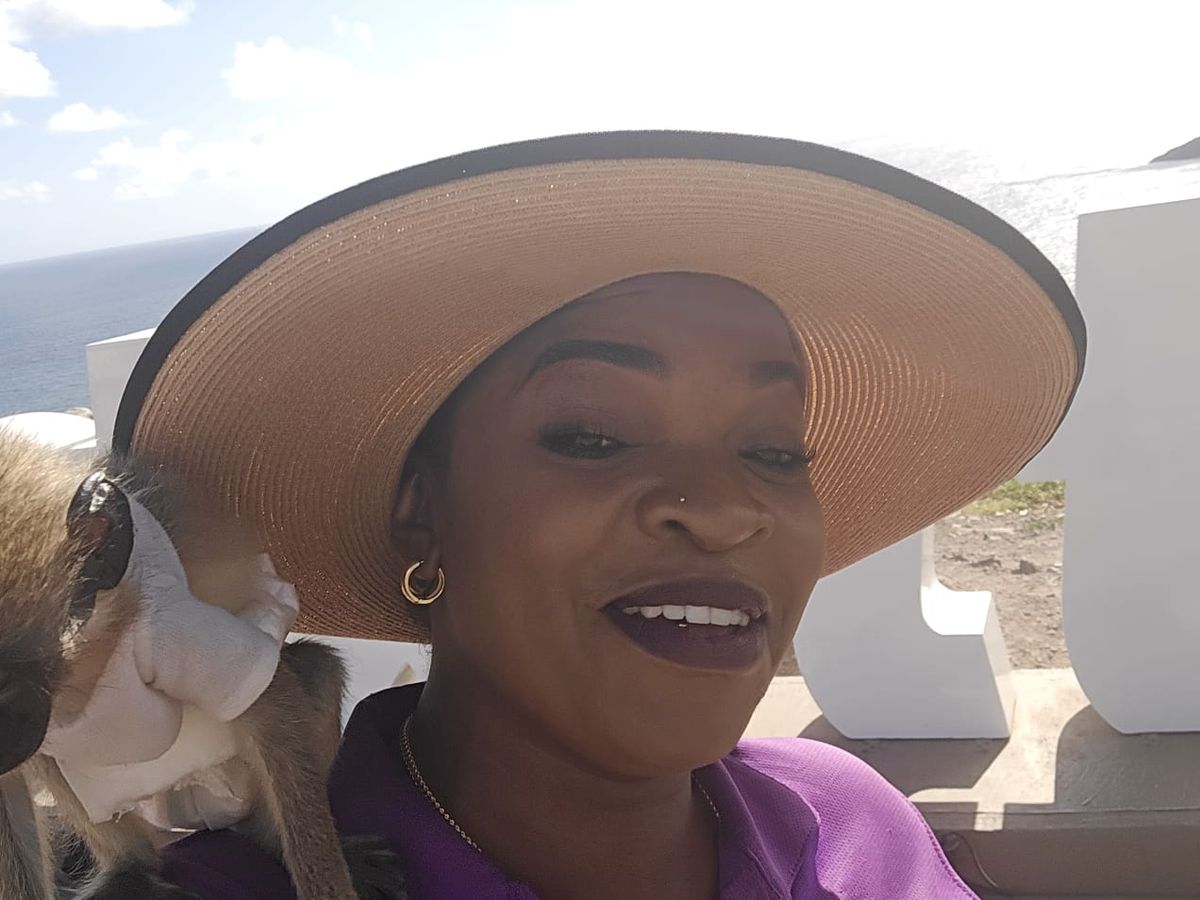
At Timothy's Hill and near the cruise port in Basseterre, local handlers offer photos with tame monkeys, often young ones, for a fee. It is not free and there is no set price, so agree the amount before the monkey goes on your shoulder.
A 2022 study of the island's "monkey problem" describes these "monkey men" charging visitors to hold, feed and photograph juvenile monkeys, most often around the cruise port. A few simple rules keep it pleasant:
- Ask first. Check the price for your whole group and whether you can use your own phone.
- Let the handler place the monkey. Don't grab it or pull it off.
- Keep sunglasses, hats and loose items secure, and don't offer food of your own.
- Clean your hands afterwards.
Some visitors skip handler photos for animal-welfare reasons and prefer watching wild troops from the roadside, which costs nothing. Either way, never try to pick up a wild monkey.
Can you touch or feed the monkeys?
No. Don't touch or feed wild monkeys. Fed monkeys learn to link people with food, grow bolder, and are more likely to grab bags or bite.
Keep food zipped in bags on the beach and in the car, and close the windows if you stop near fruit trees. Don't leave snacks on a beach chair while you swim.
Feeding also makes the farm problem worse. An agriculture expert in the 2022 study said the monkeys have come to associate humans with food.
Are the monkeys in St. Kitts dangerous?
Not usually. Wild vervets keep their distance, and most visitors only see them from a car or a lookout. Trouble starts when people feed, corner or grab them.
They are still wild animals with sharp teeth. Injuries to residents and tourists came up in 13 of 17 discussion groups in the 2022 study, so keep children from reaching out and give mothers with babies plenty of room.
If a monkey scratches or bites you, wash the wound well with soap and running water and see a doctor the same day.
Why are there monkeys in St. Kitts?
Because people brought them. The species is the green monkey, Chlorocebus sabaeus, from West Africa; on the island most people call them vervets or green vervets.
They arrived in the 1600s on ships of the colonial slave trade, most likely as pets, and escaped or were released into the forest. Over the centuries they spread across St. Kitts and Nevis.
While sugar cane covered the lowlands, most troops stayed in the mountains. After sugar production ended in 2005, they moved down into farms, villages and beaches.
Hikers on the Mount Liamuiga hike may meet troops in the rainforest higher up.
How many monkeys are in St. Kitts?
Nobody knows exactly. Every number you will see is an estimate, and they vary:
- About 25,000 on St. Kitts and Nevis, from a primate specialist's study reported by AP in 2011.
- About 38,000 to 40,000 on St. Kitts alone in 2020, an unpublished estimate cited by the 2022 study and the Dutch Caribbean Nature Alliance.
The 2020 estimate is close to the island's human population, which is why you often hear that monkeys outnumber people. Treat that as a rough comparison, not a count.
The monkeys and local farmers
For farmers, the monkeys are a serious pest. Research cited in the 2022 study found that 50 to 75 percent of farms on St. Kitts face monkey damage, mostly to fruit and vegetable crops.
The government supports trapping. In 2020 the prime minister urged trappers to "get busy" and floated planting crops in the mountains so troops have less reason to come down, as reported by the government information service.
So the same animal is a favorite at the lookouts and a real cost for the farmer down the road. Not feeding them is the easiest way visitors can help.
Green vervet monkey facts
| Fact | Detail |
|---|---|
| Species | Green monkey, Chlorocebus sabaeus; locally "vervet" or "green vervet" |
| Native range | West Africa |
| Arrived in St. Kitts | 1600s, by ship, during the colonial slave trade |
| Estimated population | Roughly 38,000 to 40,000 on St. Kitts (2020 estimate; no exact count) |
| Weight | Males about 4 to 8 kg (9 to 18 lb); females about 3.5 to 5 kg (8 to 11 lb) |
| Body length | About 30 to 50 cm (12 to 20 in), plus a long tail |
| Diet | Mainly fruit and leaves, plus flowers, roots and sap; on St. Kitts also farm crops |
| Troop size | About 7 to 80 in their native range |
| Lifespan | Up to about 13 years in the wild |
Size, diet and lifespan figures are from Animal Diversity Web (University of Michigan).
See the monkeys with a local driver
Our Panoramic Tour stops at Timothy's Hill, and our South Friars beach round trip often passes monkeys on the way. Send your date, group size and pickup point. A 20% deposit holds your day, and cruise guests get our back-to-ship promise: we get you back to the ship on time.
St. Kitts monkeys: FAQs
Will I see monkeys on a cruise stop in St. Kitts?
Very likely, if you leave the port area. Handlers with tame monkeys are often near the cruise port and at Timothy's Hill, and wild troops are common on the Southeast Peninsula road. A 2 to 2.5 hour Panoramic Tour or a South Friars beach trip fits easily into a normal port day.
How much does a monkey photo cost in St. Kitts?
There is no fixed price. Handlers set their own amount, so ask before the monkey is placed on you, and check whether it covers your whole group and photos on your own phone. Carry small US bills. Tour prices do not include these photos.
Are there monkeys on Nevis too?
Yes. Green vervets live on both St. Kitts and Nevis, and farmers on Nevis report the same crop losses. If you take the water taxi across for the day, you may see them in the hills and around farms there too.
Are the monkeys in St. Kitts native?
No. They are a West African species brought over in the 1600s. Conservation groups treat them as an invasive species because they damage crops, and researchers are still studying how much they affect native plants and wildlife.
What should I do if a monkey grabs my food or bag?
Let it go. Don't chase it or pull back, because that is when bites happen. Step away, keep the rest of your food zipped up, and move on. Next time keep snacks out of sight, especially at beach bars and lookouts.
Sources
- Gallagher et al., Understanding Community Perceptions of the St. Kitts' "Monkey Problem", Frontiers in Ecology and Evolution (2022), checked October 2026.
- Animal Diversity Web, University of Michigan: Chlorocebus sabaeus, checked October 2026.
- Associated Press via NBC News: Cook 'em? Monkeys have islanders weighing options (2011), checked October 2026.
- Dutch Caribbean Nature Alliance: Green monkeys, from pets to island nuisance (2023), checked October 2026.
- SKNIS (St. Kitts and Nevis Information Service): Prime Minister Harris encourages monkey trappers (2020), checked October 2026.